The Line on the Map That's Really Setting Savannah's Historic District Prices
September 17, 2026
September 17, 2026
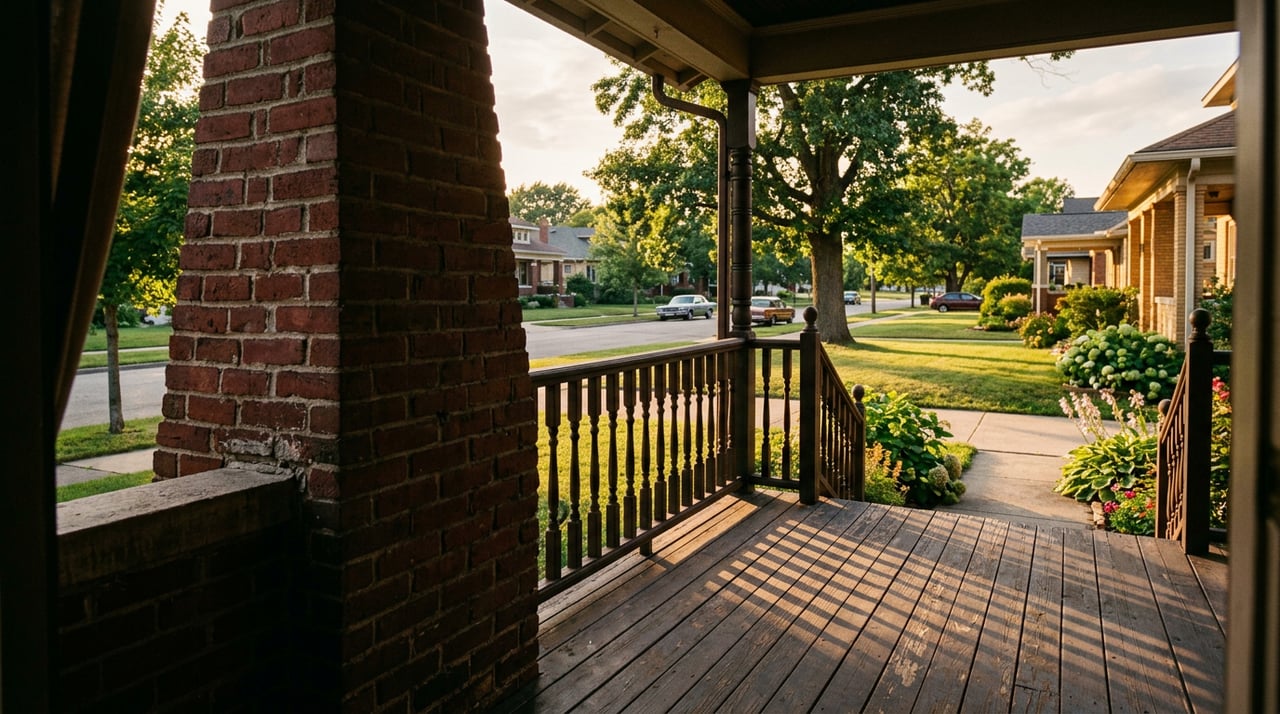
Walk down Bull Street past the construction fencing at Starland Village and you can stand in one spot and see two different Savannahs. On one side, a raw new apartment building rising where a dairy plant used to be. A block south, a run of century-old bungalows with porch swings and window units. Same street. Same live oaks overhead. And if you pulled the tax records, wildly different price logic underneath both of them.
Buyers comparing Savannah's Historic District to Midtown neighborhoods like Ardsley Park and Baldwin Park usually assume the price gap is about age, architecture, or proximity to the squares. It's actually simpler and stranger than that. A meaningful share of what you pay inside the Historic District boundary has nothing to do with charm. It has to do with a zoning line that decides whether you're allowed to rent your house out by the night.
Savannah only permits short-term vacation rentals inside three historic overlay districts: Downtown Historic, Victorian Historic, and Streetcar Historic. Outside those lines, a homeowner can't legally run an Airbnb or similar nightly rental no matter how charming the block looks. Getting a certificate to operate one costs $400 to start and $250 a year to renew, which is a small cost next to what STR eligibility does to a property's ceiling price.
That single fact changes what you're actually bidding against when you make an offer inside the Historic District. You're not just competing with another family who wants a porch and a walk to Forsyth Park. You're competing with buyers underwriting the property as an income-producing asset, because the zoning line makes that possible there and nowhere in Midtown.
A house a mile outside the overlay can be architecturally identical to one inside it. Only one of them can legally earn nightly rental income. That difference shows up in the offer, not in the listing photos.
Here's where it gets confusing if you're just scanning portal data. Search for homes in Savannah's Historic District broadly and the median listing price among currently active listings lands around $362,000. Narrow to just the South Historic District specifically, and the Zillow Home Value Index for that footprint sits at $939,202 as of July 2026, actually down 5.2% over the past year.
Those aren't typos or a data error. They're two overlapping but distinct geographies wearing the same casual label. The broader "Historic District" search catches smaller condos, fixer-uppers, and properties on the edges of the overlay that don't carry full STR eligibility. The narrower South Historic District figure captures the trophy blocks closest to the squares, where turnkey renovation and rental eligibility both concentrate, and where a slight cooling from a very high base still leaves prices well above anything in Midtown.
The lesson for a buyer isn't which number is right. It's that "Historic District" isn't one product. Before you compare a listing's price to any median you've seen online, find out which side of the overlay boundary it actually sits on and whether the parcel carries STR eligibility. That single check explains more about the asking price than square footage will.
| Area | Price signal | Time window |
|---|---|---|
| Historic District (broad search) | Median listing ~$362,000 | Active listings, 2026 |
| South Historic District (narrow footprint) | Average value $939,202, down 5.2% YoY | As of July 2026 |
| Ardsley Park (value index) | Typical value $570,574, up 10.9% YoY | 2026 |
| Ardsley Park-Chatham Crescent (sales) | 12-month median sale price $678,250, down 5% | Trailing 12 months, 2026 |
Ardsley Park was laid out in 1910 as Savannah's first planned suburb, built around curving avenues and small pocket parks that still give the neighborhood its cohesive, almost miniature version of downtown's square-based layout. Daffin Park, 80 acres designed in 1907, anchors the area with sports fields and Grayson Stadium. Victory Drive, a 19.8-mile palm-lined boulevard built in 1919 as a World War I memorial, runs straight through the middle of it. None of that is a discount version of the Historic District's story. It's a different one, and it comes without the STR-driven investor competition.
Baldwin Park sits just south, oriented around its own namesake green space with a playground and a tree-lined path connecting to Tiedman Park. It's positioned as the more walkable, more accessible entry point into the same Midtown corridor that includes Starland District, and it draws buyers who want the character without needing to be inside Ardsley Park's grander, pricier core.
Notice that the two Ardsley Park numbers in the table above don't agree either. The value index is up double digits over the past year. The 12-month median sale price is down. That's not a contradiction to explain away. It means the neighborhood's appreciation isn't moving as one block. Some price tier within Ardsley Park, likely the larger renovated homes with updated systems, is pulling the recent sales median down even as the broader index of the whole housing stock keeps climbing. If you're comparing two Ardsley Park listings, the citywide or even neighborhood-wide number won't tell you much. What matters is which micro-tier the specific house belongs to.
The 117-unit first phase of Starland Village, delivering on Bull Street in 2026, is the kind of development that tends to run ahead of single-family price movement rather than behind it. It sits within walking distance of Starlandia Art Supply, Vittoria Pizzeria, The Wyld Dock Bar, Big Bon Bodega, Water Witch Tiki, and Green Truck Pub, the same cluster of businesses that gave Starland District its identity as a walkable arts corridor after the old dairy plant that once anchored the neighborhood closed in the late 1980s.
New rental supply at that scale is a demand signal, not just a lifestyle amenity. It means enough people want to live in this specific stretch of Midtown that a developer bet 117 units on it. For a buyer looking at Ardsley Park or Baldwin Park as an alternative to the Historic District, that's worth reading as early evidence that the corridor's foot traffic and daily life are strengthening, independent of whether any of those homes will ever qualify for a short-term rental certificate.
Can a Midtown home in Ardsley Park or Baldwin Park ever gain short-term rental eligibility? Not under the current ordinance. STR certificates are tied to the three historic overlay districts specifically, and that boundary would need a city ordinance change to move, not a rezoning of an individual parcel.
Does being in the Historic District automatically mean stronger resale value? Not on the numbers right now. The South Historic District's value index was down 5.2% year over year as of July 2026, while Ardsley Park's was up 10.9% over the same stretch. Historic designation buys you scarcity and, in the right overlay, rental flexibility. It doesn't buy you a guarantee that the line moves up every year.
If you're trying to figure out which side of that overlay line makes sense for your budget, your timeline, and whether rental income is even part of your plan, that's exactly the kind of conversation worth having before you start touring. Jenna Green works both sides of this comparison across Savannah and the surrounding coastal Georgia markets, and can walk you through what a specific address's zoning actually allows before you fall for the porch. Schedule a consultation when you're ready to talk specifics.
Stay up to date on the latest real estate trends.
Combining creativity, strategy, and a hands-on approach, Jenna Green is dedicated to creating a real estate experience that feels smooth, authentic, and centered around your success.
Jenna Green | Weichert REALTORS®
[email protected]
M: 850-687-6865
O: (912) 373-7653
9AM - 8PM | MON - SAT
9AM - 7PM | SUN
Richmond Hill, GA 31324