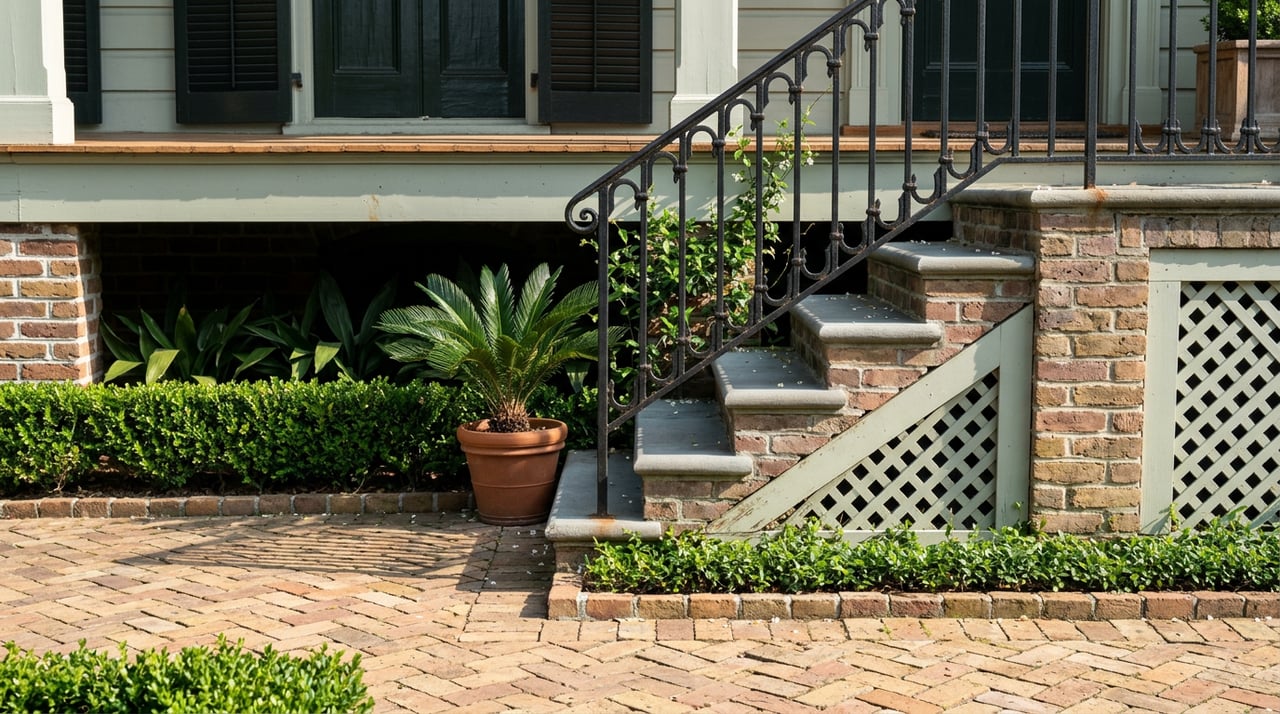
In Savannah's Historic District, an Active Termite Bond Isn't the Guarantee You Think It Is
September 17, 2026
September 17, 2026
A listing sheet that says "active termite bond in place" reads like reassurance. For a lot of Savannah buyers, it functions as the moment they stop worrying about wood-destroying insects and move on to paint colors. That's the wrong moment to relax, and if you're looking at a pre-1960 home inside the Landmark District, it's worth understanding exactly why before you're three weeks into a due diligence period.
A termite bond and the report your lender will actually require are two different documents, built for two different purposes, and one does not guarantee the other. In a city where original heart pine framing is common and termite pressure runs close to year-round, that gap is where Savannah historic home purchases get complicated at the worst possible time.
A termite bond is a service agreement. A licensed pest control company treats the property, then commits to annual inspections and, depending on the tier, retreatment or repair if termites return. It's ongoing. It's forward-looking. It says someone is watching the house.
The document your lender wants is different. Georgia calls it a CL-100, and it's a point-in-time Wood Infestation Report completed by a licensed inspector, typically required within 30 days of closing for FHA and VA loans and expected by nearly every conventional lender as well. It's a snapshot: what does this house look like today.
Here's the part that catches buyers off guard. An active bond does not guarantee a clean CL-100. The inspector doing the point-in-time report can still find damage that happened before the bond's treatment ever started, or in an area the bond's exclusions never covered. The two documents can legally disagree with each other, and when they do, the CL-100 is the one your lender listens to.
| Termite Bond | CL-100 / Wood Infestation Report | |
|---|---|---|
| What it is | Ongoing service contract with a pest control company | Point-in-time inspection report |
| Time horizon | Renews annually, follows the property forward | Valid for a single moment, usually within 30 days of closing |
| Who requires it | Optional, but common on Savannah listings | Virtually all mortgage lenders |
| What it proves | Someone is treating and monitoring the property | Current condition, active infestation status, visible past damage |
| What it doesn't prove | A clear inspection at closing | Ongoing protection after the report date |
Most bonds on the market are retreat-only. That means if termites come back, the company treats again at no charge, but you're on your own for repair costs. A smaller share of bonds include a repair warranty, which adds damage coverage on top of retreatment, typically capped somewhere between $25,000 and $1,000,000 depending on the provider and the tier the previous owner purchased.
In Georgia's climate, where subterranean termites can forage nearly year-round in the southern half of the state, a bond costs more here than in a lot of the country. Coastal Georgia and Florida both trend toward the upper half of the national range, with basic bonds running roughly $250 to $500 a year as of 2026. That's not a discretionary add-on for a lot of local homeowners. It's closer to a standing utility bill.
The exclusions are where things get genuinely uneven. Georgia's Structural Pest Control Act requires disclosure but doesn't mandate uniform exclusion language across companies, which means one bond's fine print can look nothing like another's. Areas a technician can't physically inspect, like sections of a crawl space blocked by insulation or a sub-slab void, are commonly excluded no matter who wrote the contract. Ask for the actual document, not a summary, and read what's carved out before you assume the coverage matches the peace of mind the word "bond" implies.
Savannah's climate makes termite damage close to a given for older housing stock, and pre-1970 homes, especially inside the Historic District with original wood framing, carry the highest incidence of it. That's not a reason to walk away from a 1920s row house. It's a reason to know what a positive finding actually costs before you're negotiating repairs on a deadline.
Minor treatment on a standard finding runs a few thousand dollars. Structural damage from Formosan subterranean termites, a species with an established population along the coast and colonies far larger than native Eastern subterranean termites, can run $15,000 to $40,000 or more in remediation and repair. For pre-1960 structures with original heart pine framing, and heart pine is everywhere in Savannah's older housing stock, repair costs can approach or exceed what you'd spend on a serious renovation, sometimes landing in the $30,000 to $60,000 range.
That's the number that should shape your offer strategy, not the presence or absence of a bond on the listing sheet.
Here's the wrinkle that's specific to buying inside Savannah's historic overlay, and it's the one generic termite guides never mention. If a CL-100 turns up damage to a porch, window sill, or exterior siding on a contributing structure, the repair itself may need Historic Review Board approval before work starts, particularly if the fix involves replacing material rather than patching it in kind.
The Metropolitan Planning Commission's own guidance on building in the historic district is direct about this: any work affecting a building's exterior is subject to review, some of it approvable at the staff level, some requiring a public hearing before the review board. In-kind repair, meaning a fix that doesn't change the material, placement, or design of the original feature, moves faster. Anything else can add weeks to a timeline that a standard due diligence period was never built to absorb.
Unresolved historic-review issues on a property don't just complicate your repair plan. They can affect the closing itself, buyer confidence, and resale value down the line, which is exactly why a home inspector with historic-home experience matters more here than it would in a newer subdivision. Budget for HRB-compliant materials specifically. Historic-compatible repair, matching original wood species and profile rather than swapping in standard modern stock, routinely costs more than a straightforward replacement would.
Even a good bond can lapse in the handoff. Some contracts void coverage if the transfer isn't completed within 30 days of closing, and the process usually requires contacting the pest control company directly to document the ownership change before that window closes. Yates-Astro, a Savannah-area company that has operated locally since 1928 and describes itself as the largest pest control provider in Southeast Georgia, is one example of the kind of established local operator whose records tend to be well organized for exactly this kind of transfer. Whoever holds the bond, put the transfer on your closing checklist with a date attached, not a someday.
Is a termite bond required to sell a home in Georgia? No. State law doesn't require it, though most lenders will require a current CL-100, and many sellers maintain a bond because it supports the file and reassures buyers.
If the CL-100 finds old damage, does that kill the deal? Not automatically. Georgia's property disclosure law requires sellers to disclose known material defects, including termite history, so past damage on its own isn't disqualifying. What matters is whether it's active, whether it's structural, and whether the repair estimate is something you can negotiate into the price or the seller's pre-closing obligations.
Does a historic designation mean I can't ever replace damaged wood? No. The Metropolitan Planning Commission is clear that in-kind repair is generally straightforward. The friction shows up when a repair shifts into a material change, a full replacement, or an alteration to a character-defining feature like a porch or window opening.
A termite bond tells you a house has had attention. It doesn't tell you what a lender-required inspection will find, and it doesn't tell you what that finding will cost to fix inside a district where the repair itself has to satisfy a review board before it satisfies your contractor. Knowing the difference before you write an offer is what turns a historic Savannah purchase from a gamble into a plan.
If you're weighing a Historic District property and want a clear-eyed read on what a specific home's inspection and preservation exposure actually looks like, Jenna Green can walk through it with you before you're locked into a timeline. Schedule a consultation and go into your offer with the full picture.
Stay up to date on the latest real estate trends.
Combining creativity, strategy, and a hands-on approach, Jenna Green is dedicated to creating a real estate experience that feels smooth, authentic, and centered around your success.

Jenna Green | Weichert REALTORS®
[email protected]
M: 850-687-6865
O: (912) 373-7653
9AM - 8PM | MON - SAT
9AM - 7PM | SUN
Richmond Hill, GA 31324