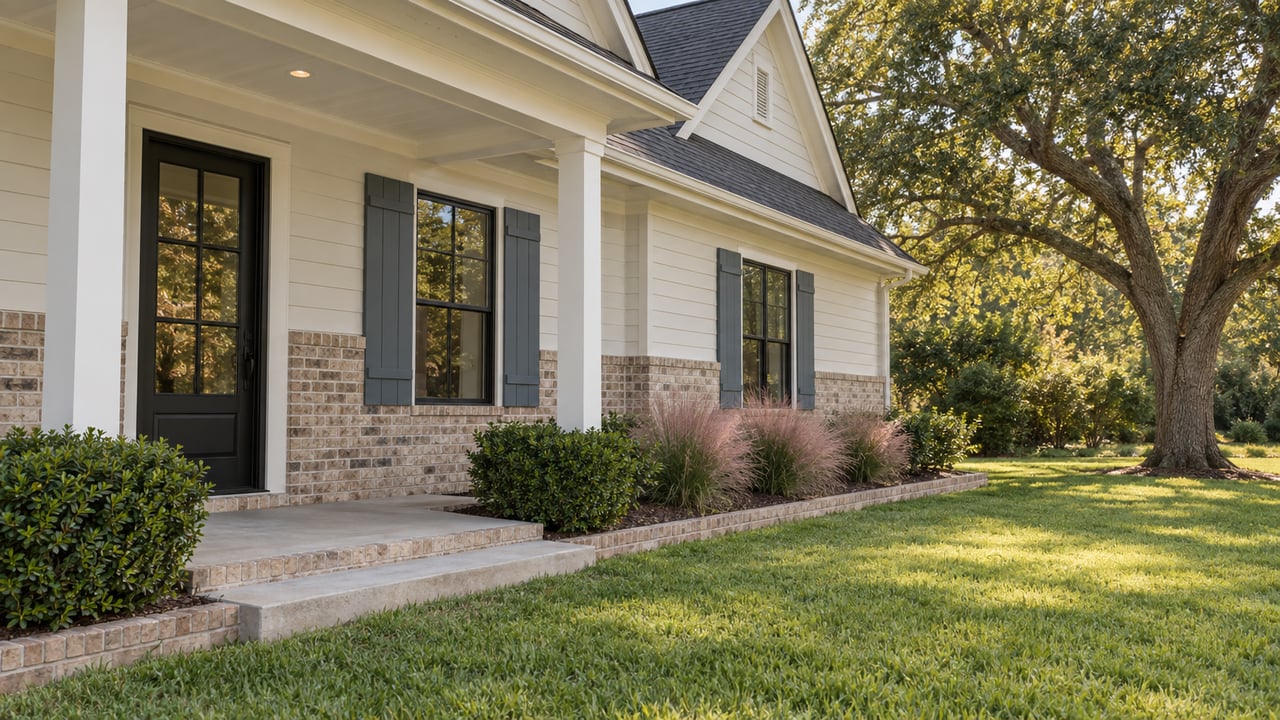
Guyton Property Values and the Data Center Near Belmont Glen
October 1, 2026
October 1, 2026
On a warm Friday night, the recreation area at Belmont Glen fills up fast. Kids ride bikes, swim in the neighborhood pool, fish in the lake, and chase each other across the basketball and tennis courts until the sky goes dark enough to see stars. It's the kind of scene that sells a subdivision better than any listing photo, and for years it's part of what drew families to this pocket of Guyton in Effingham County.
Lately, something has changed. "For sale" signs have started showing up on lawns throughout Belmont Glen, as plans for a data center across Hodgeville Road became public: a 1,400-acre OpenAI data center campus known as Project Camellia, proposed for construction inside the Savannah Gateway Industrial Hub. If you're weighing a purchase anywhere in Guyton right now, the project and its zoning context are worth understanding before you buy. It's a zoning story that may be relevant beyond this one subdivision in the Effingham growth corridor.
Belmont Glen residents describe the wooded tract across the road the way you'd describe any patch of undeveloped land near a subdivision: they called it the Christmas tree farm. Many moved in before the Savannah Gateway Industrial Hub broke ground in 2019, when the land had sat quiet for two decades and industrial development felt like a distant hypothetical rather than a plan already on paper.
It wasn't undecided. According to Effingham County manager Tim Callanan, the industrial parcel and the land that became Belmont Glen were once part of one much larger tract owned by International Paper. The county's Industrial Development Authority determined that a portion of that tract was better suited to industrial use and condemned much of it back in 2004. The remaining piece, on the residential side of Hodgeville Road, stayed under planned-development zoning meant for housing. Two zoning designations, drawn on the same original tract more than twenty years ago, produced the exact arrangement now playing out: a subdivision and two elementary schools sitting a few miles from a site now proposed for a hyperscale data center backed by a planned 500kV transmission line.
That gap between what land looks like and what it's zoned for matters to buyers. The trees did not determine the land's zoning; the designation did.
Some Belmont Glen residents say they did not know about the industrial zoning across the street when they bought their homes. Others knew the land was zoned industrial and assumed, reasonably enough, that twenty years of inactivity meant it would stay that way. Both assumptions ran into the same wall once the OpenAI announcement went public.
In reporting by the Effingham Herald, John Smith, whose home sits roughly a thousand yards from the proposed site and who now chairs a resident group called Protect Effingham Alliance, said: "A hyper scale data center wasn't a thing when I decided to move here, and I had no idea that it could be considered to be so close to my property." He added that a use of this scale "wasn't on the permitted uses table when I moved here."
Residents are suing Effingham County over a zoning change that expanded what industrially zoned land in the county could be used for, arguing that the underlying question isn't whether a data center is legal there but whether it should be.
The Effingham Herald quoted Elizabeth Fisher, a Belmont Glen resident since 2019, saying: "We're scared we're going to lose our oasis, that our serenity is going to be disrupted."
The Effingham Herald quoted Crystal Hayes, another resident, saying: "Data centers don't belong in the middle of residential areas and in the middle of schools."
None of this means the county acted outside its authority. The relevant distinction is between the land's visible condition and its zoning designation.
Effingham County's side of this is worth understanding on its own terms, because it shapes what actually gets built and how close it sits to rooftops. According to the Bryan County News, Callanan said the county tried to persuade the industrial land's owner, OmniTRAX, to pursue a less intensive use before the data center proposal came together, but those discussions didn't change the zoning outcome. He argues a data center is a lighter use than what else could have gone into that industrial park: "I understand people's concern because data centers have earned the reputation that they have. But what is proposed here is not remotely similar to what has been put in places like Virginia."
The preliminary site plan includes a 300-foot buffer, an existing berm, and an acoustic wall, and county officials point to Effingham's industrial buffer and downward-facing, shielded lighting requirements as guardrails. Callanan said OpenAI has agreed to commitments beyond what county code already requires for noise and lighting.
Brandt Herndon, CEO of the Effingham County Industrial Development Authority, described a pattern common to fast-growing counties: industrial, commercial, and high-density residential development often cluster around the same water, sewer, road, and electrical infrastructure, and industrial sites can sit identified for years before anything gets built on them. The Effingham Herald quoted him saying: "ECIDA does not pursue every project that expresses interest in the community." He continued: "It is not uncommon for us to decline or step away from projects that do not align with available infrastructure and resources, the characteristics of a particular site, or broader community interests." Effingham County has also floated the possibility that a completed data center deal could reduce the local school tax rate, one more variable in a project with both costs and benefits still being worked out in public.
In August, county commissioners approved a second reading of Ordinance 2026-352, which amended the zoning ordinance's planned use table to expand the ability of already industrially zoned properties to permit data centers. A lawsuit filed in early September by residents argues the county skipped a required public hearing when adopting that ordinance and asks the court to declare it invalid, along with seeking attorney's fees for an alleged violation of Georgia's Open Meetings Act.
U.S. Senator Raphael Warnock visited Belmont Glen on August 28, toured the neighborhood with Smith, and met with residents at Zion Lutheran Church in Guyton. He called for a moratorium on data center construction until communities have a more meaningful voice in the process, and, as reported by the Effingham Herald, remarked on the site's location near Blandford Elementary School: "I'm struck by the location." Savannah Mayor Van Johnson has weighed in on the broader trend too, telling residents that no city in the region is exempt from the pressure of data center growth, Savannah included. The Current reported Johnson saying: "Savannah will not be immune from that pressure."
Protect Effingham Alliance, the group Smith now leads, formed out of people who had mostly never attended a county commission or Industrial Development Authority meeting before this year. They're meeting weekly now, and the lawsuit is pending.
None of this is a reason to avoid Guyton. It's a reason to change what you check before you fall in love with a lot. A tree line, a vacant field, or a quiet two-lane road tells you nothing about what's permitted next to it. The zoning designation does, and in a county growing as fast as Effingham, that designation was often set years before the subdivision existed.
Before you write an offer on a home backing up to undeveloped land anywhere along the Effingham growth corridor, it's worth asking a few direct questions:
None of this shows up in a listing photo. All of it is public record, and it takes less time to check than most buyers spend picking paint colors.
Does this affect the whole city of Guyton, or just this one neighborhood? The zoning history here is specific to the parcel across Hodgeville Road from Belmont Glen and the broader Savannah Gateway Industrial Hub. It doesn't mean every Guyton subdivision has an industrial neighbor waiting in the wings, but it does mean the same due diligence applies anywhere new residential development sits near land the county has designated for industrial growth.
How do I actually find out what's zoned next to a home I'm considering? Effingham County's zoning and future land use maps are public records, and a title search will surface a parcel's zoning designation even when the land itself looks untouched. Asking for that information before you write an offer, rather than after, is the difference between a surprise and a known trade-off.
If you're weighing a lot in Guyton and want a second set of eyes on what's actually zoned around it before you get attached to the view, Jenna Green can pull that history with you and walk through what it means for the property you're considering.
This article is general information, not legal, tax or financial advice. Consult a qualified professional about your situation.
Stay up to date on the latest real estate trends.

Combining creativity, strategy, and a hands-on approach, Jenna Green is dedicated to creating a real estate experience that feels smooth, authentic, and centered around your success.

Jenna Green | Weichert REALTORS®
[email protected]
M: 850-687-6865
O: (912) 373-7653
9AM - 8PM | MON - SAT
9AM - 7PM | SUN
Richmond Hill, GA 31324